 Deutsch (de)
 English (en)
Sustainable repair in Norway
Bergen. Sustainability is becoming an ever more important part of construction. In Norway, MAURER demonstrated how replacing the centre beams can save significant amounts of CO2. The new expansion joint constructions also meet demanding requirements for corrosion protection and noise reduction.
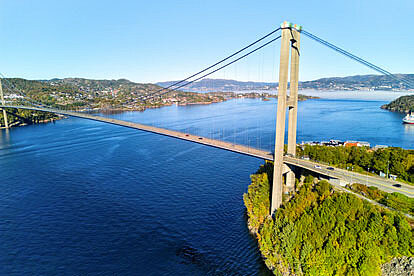
The Askøybrua (Askøy bridge) connects the island of Askøy in south-west Norway with Bergen. The suspension bridge measures 1,057 m in length, with a main span of 850 m. It has one lane in each direction, along with a cycle lane and footpath.
The bridge was opened in 1992 and by 2025, it was time to replace the expansion joint constructions at the two pylons. The joints act like expanding connections between the suspension bridge and the land on both sides. They are necessary because structures expand or rotate due to factors like temperature fluctuations, wind and traffic load. This requires an expansion joint construction that can also be safely driven over by traffic.
MAURER provided the Askøy project with two noise-reduced XS10 Hybrid swivel joists with thermal spray zinc-aluminium corrosion protection (TSZA, see below for details).
Swivel joist expansion joints have been used successfully in demanding bridge projects for decades. On the Askøy bridge, they allow for movements of up to 1,000 mm and rotations in all directions. The swivel joists support the nine parallel centre beams (lamella) sitting on top. These joists run at a slight angle to the direction of travel, therefore ensuring that the bridge’s expansions and contractions are spread evenly across the sealing elements between the steel profiles. MAURER swivel joist expansion joints are fitted with MSM®, a high-performance sliding material for bearings and springs. MSM® ensures constraint-free movement, therefore boosting the durability of the expansion joints and the bridge.
Centre beams replaced instead of entire expansion joint
To complete the renovation as quickly and sustainably as possible, only the centre beams were replaced instead of the entire expansion joints. Doing so meant connecting to the steel on the bridge side, while the joist boxes remained in the concrete on the other side. This significantly reduced CO2 emissions, as it eliminated the need to completely remove the expansion joint construction, dispose of the removed material, and install large quantities of new steel, concrete, etc.
The use of durable hybrid constructions also contributed to this reduction, as verified by sustainability calculations.
The work on the expansion joint construction was largely conducted overnight. Due to the bridge’s two-lane configuration, this was the only way to close one of the lanes. During the day, the flow of traffic was unimpeded. This was achieved through the use of steel bridges that were fitted over the expansion joint and allowed vehicles to pass over. The new center beams were each fitted together across the full width of the bridge. Installing them required a full bridge closure of around 12 hours across two weekends in October 2025.
Supervisor on site
Consolvo AS was responsible for the entire project. MAURER sent a supervisor to support the team during the removal and installation of the expansion joint constructions. Using a single supervisor rather than an entire assembly team reduced travel costs significantly and was also better from a sustainability perspective.
The expansion joint is subjected to major stresses due to the saline atmosphere over the water, the weather, condensation and the use of de-icing salt. With this in mind, the centre beams had a hybrid design and the whole package featured a particularly sophisticated corrosion protection system. The upper section that is driven over is made of stainless steel, while all other components were treated with a 200 µm ZnAl15 zinc-aluminium thermal spray.
Welded-on plates
As the southern end of the bridge lies directly next to the Kjøkkelvik district of Bergen, the expansion joint also required noise reduction. MAURER’s solution to this problem has proven itself for decades: specially profiled rhomboid plates welded onto the surface. These reduce noise levels by 30 to 50 %. Welded plates last much longer than screwed elements that can become loose after being driven over countless times.