 Deutsch (de)
 English (en)
Adaptable bearings for the Bernabéu stadium
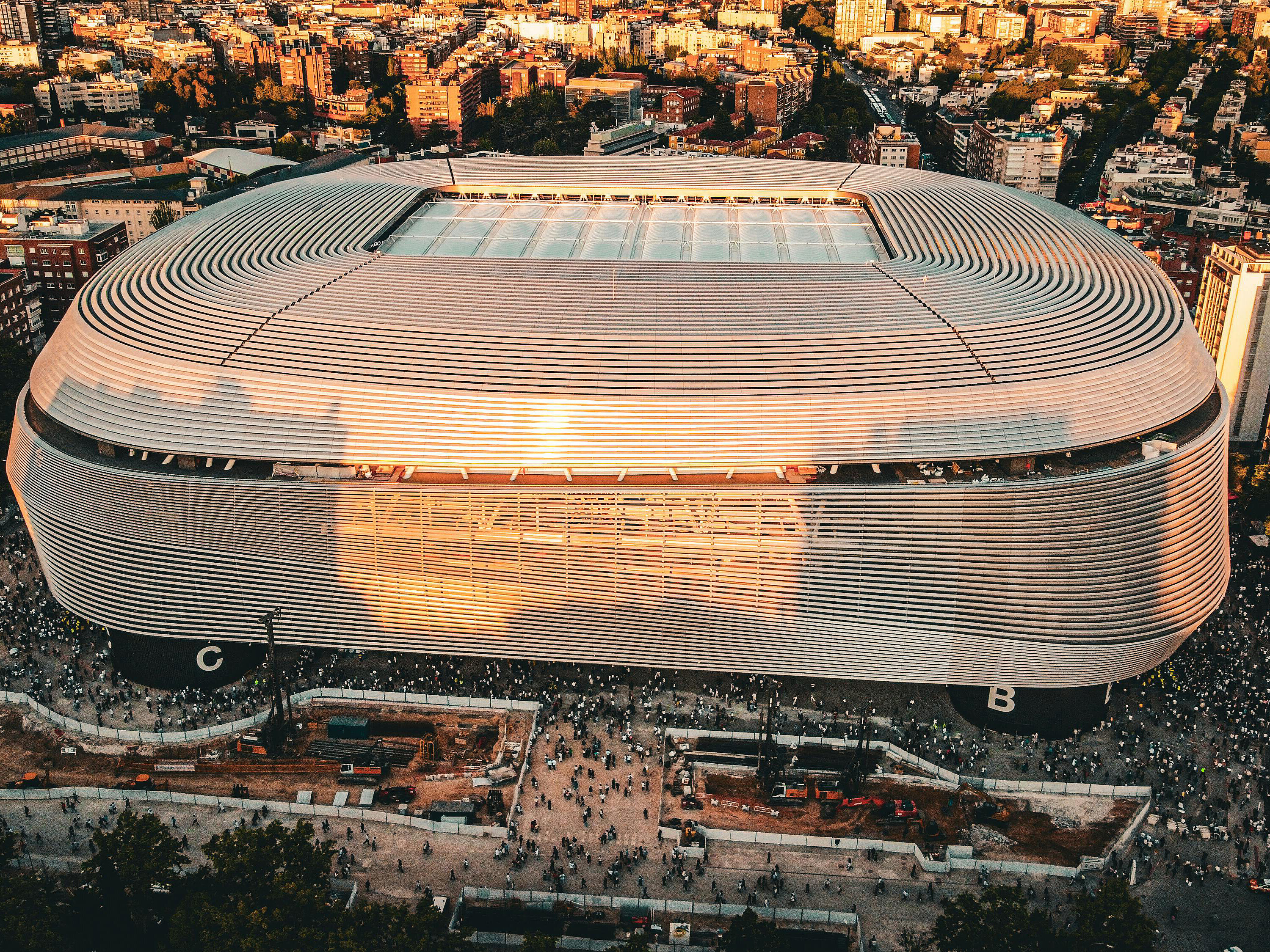
Madrid. The comprehensive modernisation of the Bernabéu stadium includes a new, fully retractable roof, along with precisely coordinated structural and support systems. As the work continued throughout the football season, the various interim construction phases placed huge demands on the bearings. MAURER mastered these challenges using spherical bearings with three sliding surfaces. These were capable of absorbing enormous loads, and were converted from the initial flexible bearings into guided ones.
The Bernabéu (known as the Santiago Bernabéu Stadion until 2025) is home to Real Madrid and is one of the most famous football stadiums in the world. But even famous buildings begin to show their age at some point. The stadium was given a completely new, larger envelope, more seats, new access routes, more shops and catering facilities, a retractable pitch to allow for concerts and other events, a skywalk and a visitor zone around the stadium. Most importantly, it also received a new roof above the pitch.
This large, technically sophisticated structure, with a new, fully retractable roof, called for precisely coordinated structural and support systems. The Spanish football giants turned to the home to one of their greatest rivals, Munich, and the expertise of bearing specialist MAURER.
67 MN of vertical load
MAURER provided four large MSM® spherical bearings for the new roof, each designed for a vertical load of 66,900 kN. These bearings absorb the central static and dynamic loads of the roof. Thanks to their design and the strong, low-wear MSM® sliding material on all the sliding surfaces, they play a key role in keeping the entire construction safe, reliable and durable.
The bearings were bolted to the first segment of the roof structure when it was installed. All connecting surfaces were processed fully mechanically to ensure a safe transfer of forces. The bearings were then welded to the tripods (three-legged load distribution elements) at the towers, in order to precisely convey the enormous loads from the four corners of the stadium’s roof into the supporting components.
One bearing throughout multiple construction phases
One of the particular engineering challenges was the need for the bearings to adapt to different roles. Most of the work took place while the football season was ongoing. This led to multiple temporary construction situations that all had to be mastered by the same bearings.
During the construction and assembly phase, they acted as type KGa bearings, which could move horizontally in all directions. This allowed them to safely absorb the relative movements of ±55 mm in the X axis and ±100 mm in the Y axis that occurred during construction due to tolerances, subsidences and other displacements, all without restraints. This meant that the roof construction could always be kept in its intended position, or moved slightly if necessary, despite the complex assembly processes and load shifts.
The required rotation of ±30 rad was also very high, and could only be achieved using spherical bearings. The internal calotte (the orange semicircle in the diagram below) acts here like a joint.
Following the construction phase, the bearings were adjusted. They were fixed in the X axis so that they could only move in the transverse direction, effectively making them type KGeq spherical bearings. With a movement range of ±100 mm, they compensate all relative displacements during operation, including temperature expansions, wind loads and dynamic effects. The newly directed bearings reliably convey the wind loads of 3,750 kN.
Additional sliding plate
The needs of the two functional phases led to the installation of an additional sliding plate beneath the bearing (the grey sliding plate at the bottom of the diagram). The combination of MAURER MSM® and the stainless steel plate initially enabled full horizontal movement with low sliding friction of no more than 1.2 %. After the assembly phase, filler plates (brown in the diagram) were inserted between the bearing and a bolted-on guide, in order to fix the movement of the temporary lower sliding plate in the X axis. This converted the bearing to its permanent final operating state.
This adaptive bearing solution enabled a technically demanding transformation project to be completed successfully. It both responded to the needs of the various construction phases and safeguarded the long-term operation of the new stadium roof optimally. The MSM® spherical bearings used ensure the operational reliability and durability of the renovated Bernabéu.
The bearings were fitted in 2021. Construction work on the stadium finished in 2025, while work inside the stadium continues in 2026.
The developer was Real Madrid CV, which owns the stadium, and the construction firm was FCC (Fomento de Construcciones y Contratas).