 Deutsch (de)
 English (en)
Seismic isolation for a critical mountain viaduct
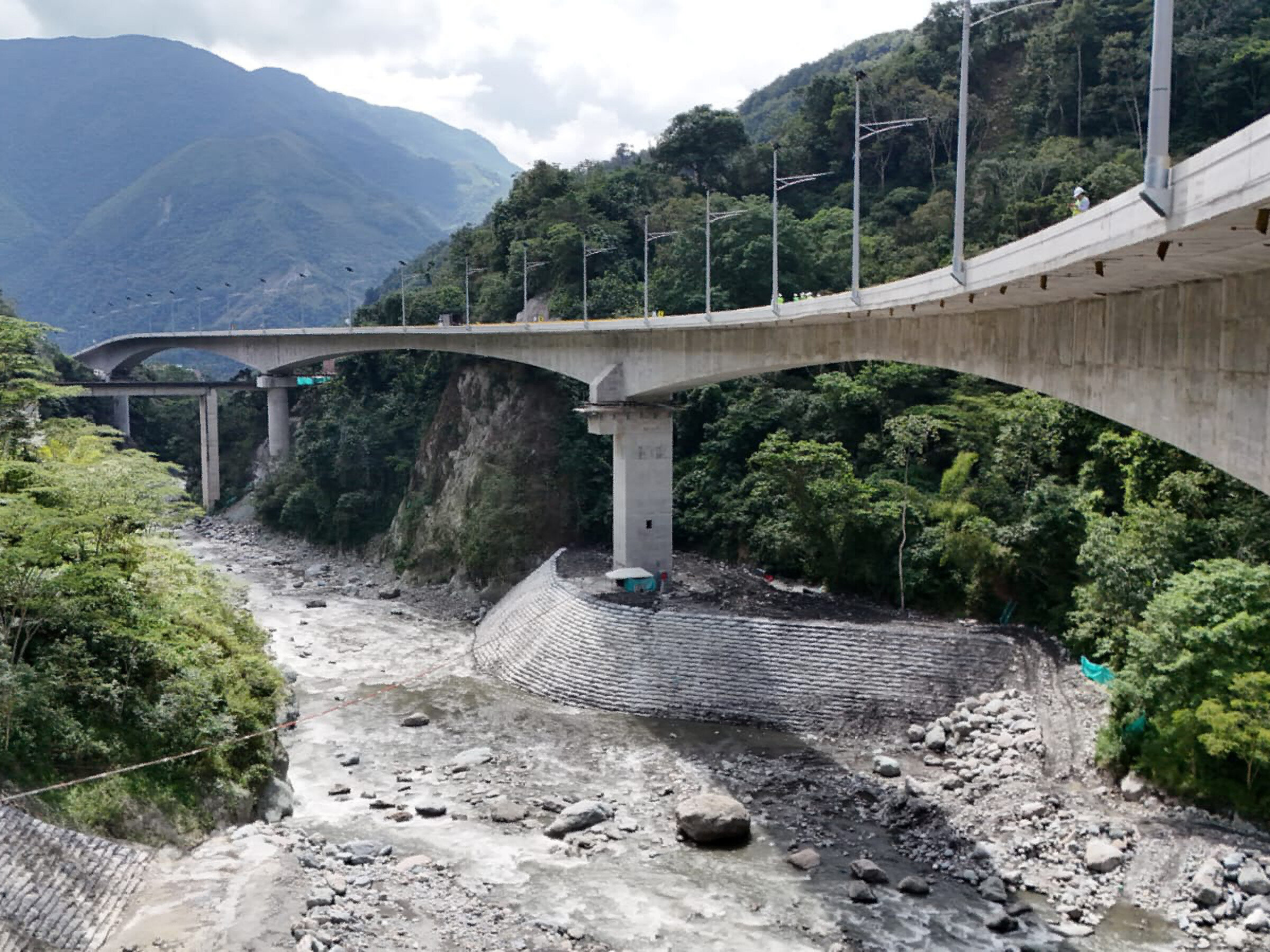
Colombia. Some bridges lie in such difficult terrain that simply constructing them is a challenge. Steep slopes, frequent landslides, a mountain river and high seismic activity were the obstacles faced during the construction of the K58 viaduct on the road from Bogotá to Villavicencio. MAURER SIP®-DR sliding isolation pendulums not only bear the weight of this 720 m bridge, but also enabled smaller foundations and a leaner design, as well as safeguarding this transport artery for decades to come. The bearings absorb high vertical loads of up to 70 MN and can displace by up to 528 mm in the event of an earthquake.
The K58 is named after “kilometre 58” of the state highway (Ruta Nacional 40) from Bogotá to Villavicencio. This geological bottleneck is one of the most important road connections in Colombia. It runs alongside a steep slope over the Río Negro river, and was for decades repeatedly forced to close due to landslides, unstable embankments and earthquakes.
The key point combines steep topography, a crossing over a wild river, constantly disrupted terrain and one of the highest seismic hazard levels in the country, with peak accelerations of more than 1 g. One of the reasons for this is the active Guayuriba Fault, which runs 131 km along the eastern edge of the Andes and is just 18 km away from the bridge.
The answer: a 720-metre-long, five-field, curved viaduct over the valley that also bridges the Río Negro. The project not only had to take account of spans, load-bearing capacity, traffic safety and long-term stability, but also the challenges of simply constructing the bridge under difficult conditions.
Viaduct with sliding isolation pendulums
After investigating a number of different variants, the planning team from PEDELTA LATAM chose a seismic isolation system using sliding isolation pendulums. The support structure consists of a continuous prestressed-concrete box girder with varying height. It sits on top of four piers, each with two sliding isolation pendulums, as well as on conventional elastomeric bearings at the two abutments. The viaduct was designed so that the superstructure and substructure would essentially remain elastic in the event of an earthquake, while the non-linear response of the isolators would protect the viaduct from seismic forces.
Two analysis methods were combined, in order to simulate the bearing requirements as realistically as possible: modal response spectrum analysis and non linear time history analysis with scaled earthquake recordings for the maximum credible earthquake (MCE), with a return period of 2,500 years. A simplified displacement spectrum was used for the long period range, in order to avoid implausibly conservative results and better capture the physical behaviour of isolated structures.
Special SIP®-DR earthquake bearings
The isolation system is built around eight MAURER sliding isolation pendulums (SIP) of the type SIP®-DR. D stands for double, indicating that the bearing has two concave surfaces instead of one. D bearings can therefore be built smaller and lighter, and are easier to install. The R stands for rotation. The rotations in the range of 0.01 rad result from the varying weight distribution of the superstructure over the course of construction. Despite being made of concrete, the viaduct is still comparatively “active” in terms of movement. This is down above all to the large spans of up to 180 m.
Isolate, dissipate, centre, divert
The SIP® bearings perform four tasks:
- They isolate the bridge deck from the piers, therefore extending the oscillation period of the support structure (effective period: 4 seconds).
- They divert the seismic energy through friction (dissipation, 3 % of nominal dynamic coefficient of friction), reducing the force to protect piers and foundations (equivalent viscous damping approx. 20 %).
- They allow for displacements of up to 528 mm horizontally and centre the bridge in its original position following an earthquake.
- They convey extreme vertical loads of up to 70 MN.
Compared to a conventional monolithic solution, the SIP®-DR bearings reduce seismic shear forces at the pier heads by 44 % on average. This made it possible to design the substructure more efficiently, including optimised founda tion measurements and the use of large caissons. The bearings measure approx. 1,800 mm in diameter and 445 mm in height.
One of the challenges in designing them was the combination of high vertical loads and large displacements in the event of an earthquake. For this reason, both the prototype and production versions of the SIP® bearings were tested according to the AASHTO Guide Specifications for Seismic Isolation Design and EN 15129.
The geometry and position of the viaduct placed great demands on the construction. The viaduct was built in a balanced cantilever process due to the difficult terrain and valley crossing.
Debris flow in the Río Negro affected work on pier 2 in the early foundation phase, requiring the construction process to be adjusted. The process was divided into multiple phases, with the auxiliary structures remaining in place until the main superstructure was complete and the bearings were installed and activated.
The K58 bridge shows that SIP® bearings can do much more than just seismic protection. They enabled simpler planning and therefore better feasibility and long-term performance in a highly challenging environment.
The bearings were fitted in November 2024. The viaduct was opened to traffic on 12 February 2025. The construction firm was OHLA LATAM and the owner is INVÍAS ( Instituto Nacional de Vías), an authority belonging to the Colombian Ministry of Transport.