 Deutsch (de)
 English (en)
Sustainably crossing the Øresund
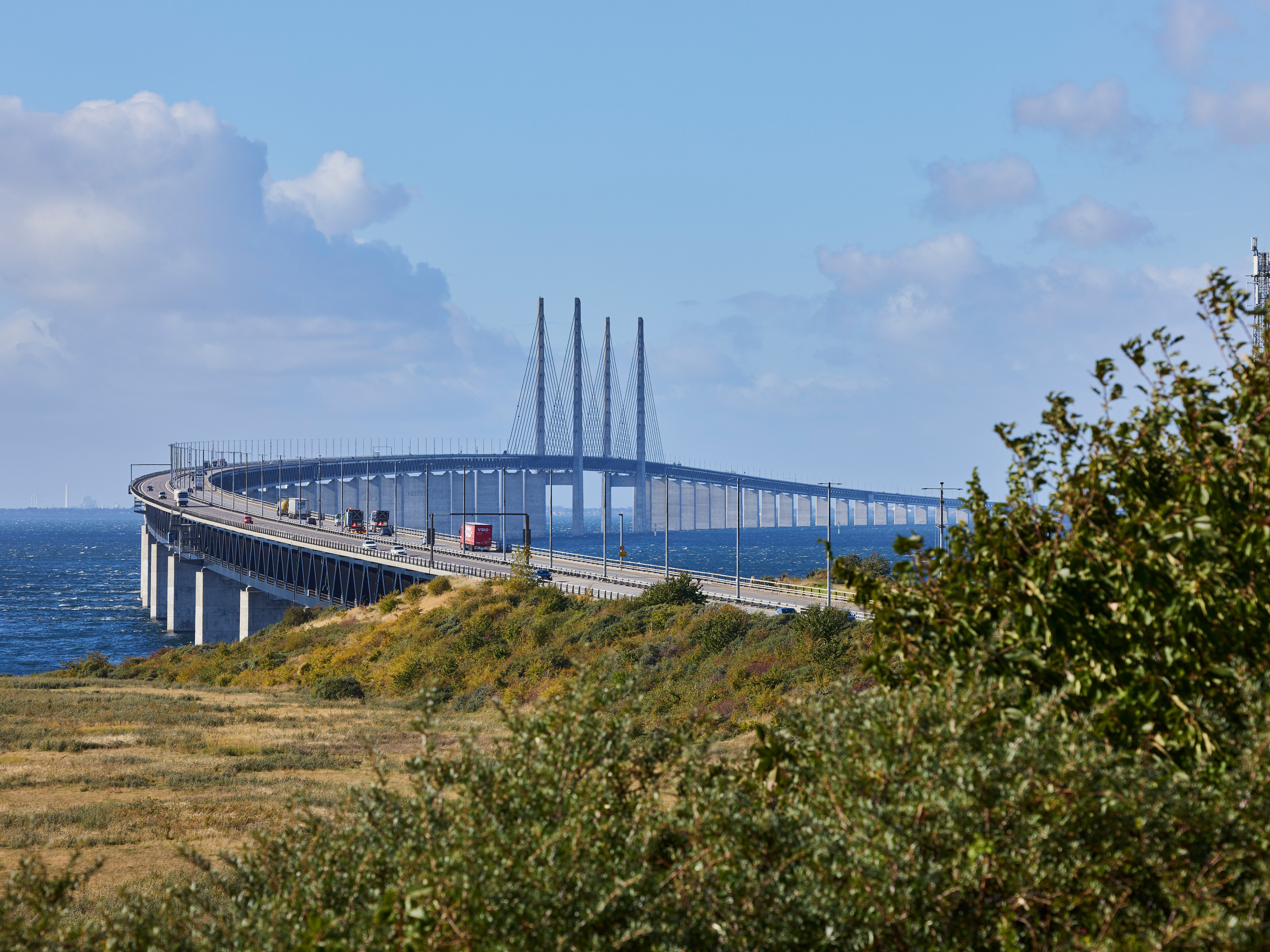
Øresund. A 25-metre-long expansion joint has been replaced on the Øresund Bridge between Denmark and Sweden. This special project combined innovative technology and sustainability. MAURER not only designed and supplied the expansion joint construction, but also managed the replacement without the need for a full road closure.
The Øresund Bridge (Øresundsbron) is the longest cable-stayed bridge for combined road and rail transport in the world. Opened in the year 2000 and with a main bridge measuring 7.8 km, it connects the Danish capital Copenhagen with the Swedish city of Malmö. The four-lane motorway runs along the upper deck, while two train lines run through the truss girders.
The bridge is part of the Øresund toll road and is owned and operated by Øresundsbro Konsortiet. The consortium is jointly owned by the Danish and Swedish states, with each holding a 50 % ownership share. As the owner and operator, Øresundsbro Konsortiet places great importance on keeping the bridge in operation for as long as possible. Eckhard Taube, MAURER’s branch manager in Lünen, explains. “We have witnessed this throughout the entire collaboration. Every question has focused on what is best for the bridge’s wellbeing, durability and sustainability.”
Sustainability anchored in call for tender
This emphasis on sustainability was a factor as early as the public call for tender for the expansion joint construction. Although the costs were the decisive factor just like any other project, these were viewed from a long-term perspective. Every aspect was assessed, from production and delivery to construction time, maintenance and service life. In the end, MAURER received the commission thanks to a cost-effective offer based on innovative technology and durable parts, as well as skilled and sustainable construction site management.
Expansion joints are fitted at each end of a bridge, or between the sections of larger bridges. They flexibly compensate the structural movements caused by traffic load, wind and temperature fluctuations. They also ensure that vehicles can drive across these junctures unimpeded, regardless of the bridge’s displacement. The joints are installed perpendicular to the direction of travel.
Modified expansion joint construction
Spring 2025 saw the replacement of the first expansion joint on the Øresund Bridge with swivel joists. Further joints are due to follow between 2026 and 2030. These sophisticated expansion joints allow for movements of 1,500 or 1,600 mm and more in some cases, as well as rotations in all directions. The parallel profiles rest on top of the swivel joists. These run at a slight angle to the direction of travel, therefore ensuring that the bridge’s longitudinal movements are spread evenly across the sealing elements between the steel profiles.
The Øresund Bridge has eight swivel joist expansion joints. The first to be installed was a DS15 Hybrid, measuring 25 m in length and weighing 22 metric tons. The 15 profiles allow for up to 1,500 mm of movement. The expansion joint has a range of features that make it particularly sustainable:
- The conventional swivel joist design was modified by using MSM® as the sliding material in the innovative bearing springs. MSM® is highly durable and has excellent sliding properties. This prevents restraints and increases the service life to at least 50 years.
- All wear parts on the expansion joint are designed for durability, such as the hybrid claws with stainless steel on top.
- Only the expansion joint was replaced. The cross bar boxes anchored in the concrete were retained. This significantly reduced the CO₂ emissions associated with removing and replacing the concrete.
- The corrosion protection was specially designed for the exposed position above the Øresund, where the bridge is attacked from above and below by salt in the wind and storms. It comprises a thermal spray zinc-aluminium coating, stainless steel and on-site zinc sprays for the retained components. All parts are free from PFAS (per- and polyfluoroalkyl substances).
- The expansion joints were transported to the bridge on electric lorries, helping to reduce transport-related CO₂ emissions.
Time is money
For the bridge owner and operator, time was a crucial factor. The expansion joint was replaced in two stages and three sections, without the need for a full road closure. The central section was replaced first, with traffic passing aroun the construction site on both sides. Next, the outer sections were replaced and welded, with traffic passing through the middle.
Another factor aiding sustainability is the specially developed monitoring system. It measures movement, temperature and humidity on both sides across the entire 25-metre length. This data is transmitted to the consortium’s monitoring centre every two hours.
Taube reports. “This project always required the most durable solutions. For us as engineers, this was great, as it allowed us to contribute our expertise and innovative prowess.” The success was also down to MAURER playing the role of general contractor. The company’s expert staff managed the entire construction site, offering an all-in-one package for a highly complex construction project.