 Deutsch (de)
 English (en)
Fuse box in bridges improves earthquake safety
New Zealand. Building a bridge over an active geological fault line is a particularly difficult challenge. MAURER responded to this by fitting its already impressive expansion joint constructions with a fuse box. The hot-dip galvanised expansion joints absorb displacements while the bridge is in service, while also reducing noise. The project also required the specialists from Munich to obtain their first ever approval in New Zealand.
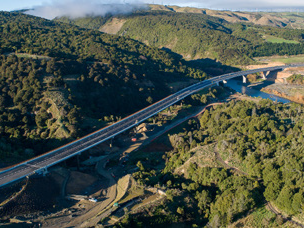
The year 2017 saw multiple landslides in the Manawatū Gorge on New Zealand’s north island, burying the State Highway 3 that runs through the gorge. Geological risks forced the repair work to be halted. Instead, the new, four-lane Te Ahu a Turanga – Manawatū Tararua Highway was built several kilometres away.
Bridge and viaduct
The new highway required the construction of two bridge structures: the EcoViaduct and the Parahaki Bridge. Each measured around 300 m in length, with the latter built around 30 m above the Manawatū river. MAURER provided the four expansion joint constructions for the project.
Fitted at both ends of the bridge, these flexible elements compensate for movements in relation to the mainland that the bridge makes due to traffic, wind and temperature fluctuations. They also ensure that vehicles can drive across this juncture unimpeded, regardless of the bridge’s displacement. The joints are installed perpendicular to the direction of travel. On top of this, the project in New Zealand presented a host of further requirements:
- Protection against earthquakes with much larger displacements
- Absorbing rotations from bridge oscillations
- Noise reduction as vehicles pass over
- Special corrosion protection due to the extreme climate
To respond to these challenges, MAURER used swivel joist expansion joints of the kind that are in use in demanding bridges around the world. They allow for movements of up to three metres and more in some cases, as well as rotations in all directions, without being damaged. The swivel joists that give these joints their name support the parallel profiles. These run at a slight angle to the direction of travel, therefore ensuring that the bridge’s expansions and contractions are spread evenly across the sealing elements between the steel profiles.
Among the things that make MAURER’s swivel joist systems special are the bearings for the profiles. Instead of simple elastomeric bearings, the steel profiles run in W-shaped MSM® bearings. This so-called catamaran support allows the profiles to glide over the joists more easily and precisely. This prevents restraints and increases the service life to over 100 years.
Expansion joints with fuse box
Two type MSM® DS5 expansion joints, each measuring 22 m in length, were installed in the EcoViaduct, while the Parahaki Bridge was fitted with two 21- m-long type MSM® DS7-F models. The number 5 or 7 indicates the number of strip seal profiles. The seven profiles allow for movements of up to 560 mm in service.
The F stands for fuse box, a system for movement reserves in the event of an earthquake. This allows for an earthquake displacement of up to 1,505 mm on the Parahaki Bridge, making these expansion joints the largest in New Zealand.
Bridge over the Wellington Fault
New Zealand is extremely prone to earthquakes. The highway runs less than 20 km away from three active fault lines, while the Parahaki Bridge crosses another fault line leading from these. The load on the bridges was determined based on the Site-Specific Seismic Hazard Assessment (SSSHA). The resulting requirements for bridge building are 20 to 50 % above those specified in the New Zealand earthquake norm NZS1170.5 (New Zealand Structural design actions, Part 5: Earthquake actions).
During an earthquake, the bridge undergoes very large displacements. The fuse boxes fitted in the expansion joints allowed their design to remain compact. The seven strip seal profiles allow for up to 560 mm of movement, which is sufficient for standard load scenarios. The fuse box only becomes active in extremely rare cases. It is triggered by large seismic closing forces, when all profiles are pressed together and the expansion joint closes fully. The fuse box prevents the expansion joint being crushed between the bridge and the abutment. Various fuse box systems are available. The variant on the Parahaki Bridge pushes the expansion joint up via an inclined steel ramp when certain weld seams at predefined points fail.
The joint itself is not damaged in this process. After the earthquake, it can still be driven over by emergency vehicles. It is then pushed back into the gap before normal traffic flows resume.
Rotations and noise reduction
Marcel Gruber, Sales Manager Asia-Pacific at MAURER, explains how the challenges in this project went beyond seismic protection: “We also had to meet the demanding specification for modular expansion joints in Australia and New Zealand. We did so successfully and in full.”
Purely by virtue of their design, the MSM® expansion joints are capable of adsorbing the specified rotations. These result from the curve in the highway. Vertical loads on the outer curve of the bridge cause the bridge deck to twist at the expansion joint.
MAURER achieved the specified noise reduction through specially profiled rhomboid plates that significantly reduce the noise level. These are welded to the upper surface of the joint. This is standard practice at MAURER, as welded plates last much longer than screwed elements that can become loose after being driven over constantly.
All four expansion joints are hot-dip galvanised with a layer measuring 140 µm in thickness. This was a special requirement of the bridge owner, in order to protect it against corrosion in the raw weather conditions of New Zealand.
The expansion joints were produced in Munich, before being shipped around the world and installed in February and April 2025. The new highway was opened at the end of 2025. The bridge is owned by New Zealand Transport Agency Waka Kotahi (NZTA), and was planned and built by Te Ahu a Turanga Alliance.