 Deutsch (de)
 English (en)
Entrances of new Stuttgart main station given freedom to move
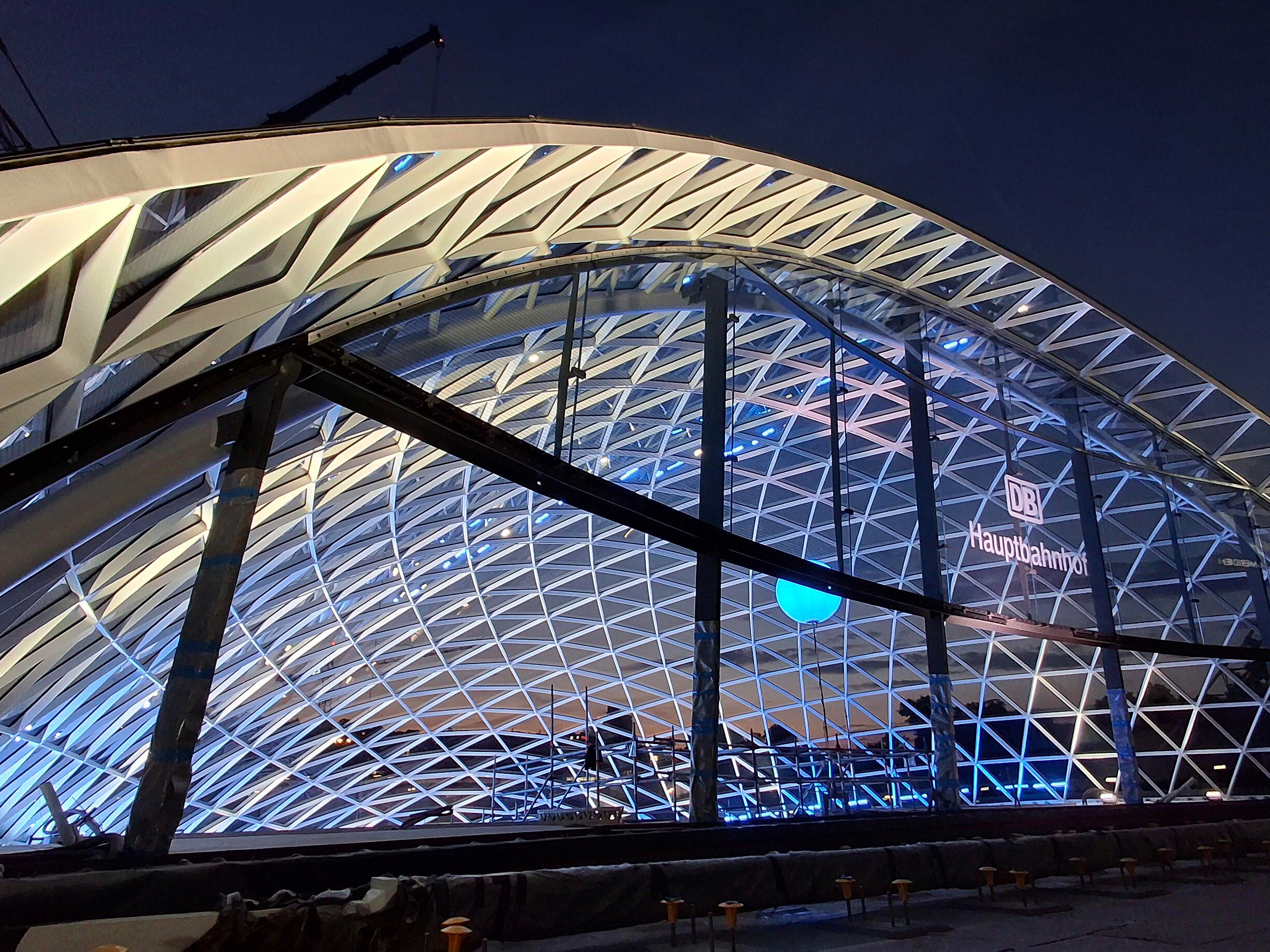
Stuttgart. A new main train station is under construction in Stuttgart, with entrances covered by large lattice shells of steel and glass. MAURER is providing special spherical bearings for these avant-garde and technically challenging structures to ensure they remain stable and flexible.
The new station will initially have three entrance structures, with another to be added in future. Covered by steel and glass shells, they will provide access to the platforms underground and are subjected to a variety of forces. Alongside the weight of the structures themselves and the imposed loads, wind and regular settlements play a major role. Due to these conditions, the measurement and design of the bearings had to allow for certain components to lift up in specific load scenarios, in order to protect the bearings or the structure.
Facade engineering specialists seele created lattice shells, located next to the State Gallery and at Kurt-Georg-Kiesinger-Platz. These sit on specially adapted spherical bearings that can absorb high forces, allow for movements and rotations, and ensure structural stability. In total, several dozen spherical bearings were installed with integrated springs. Two bearings were also fitted with rings to compensate for rotations around the vertical axis. These two bearings are guided and convey horizontal forces, therefore retaining the shell structure in its position. The other bearings enable movements in all directions, in order to prevent tensions in the structure.
Spherical bearings enable movements and free rotations around all axes
Spherical bearings are designed to meet a number of structural requirements. They enable rotations and horizontal displacements with very little resistance. MAURER also fits all its spherical bearing sliding surfaces with MSM® ( MAURER Sliding Material), with a service life of at least 50 years. This patented, high-performance sliding material is extremely strong and is capable of absorbing high loads on a relatively small surface. It contains no reclaimed materials or fillers, and no environmentally damaging components like PFAS.
Springs and rings
Given the constant load shifts, vertical lifting movements would lead to wear on the sliding material. To respond to this, the bearings were designed so that the sliding surfaces remain constantly under pressure.
MAURER added springs to the bearings in an intermediate layer beneath the actual bearing components. These enable a controlled vertical displacement within the system without conveying additional forces to the structure. Although uplift spherical bearings would have been a potential alternative, the designers wanted to avoid the transfer of tensile forces via the bearings, in order to prevent restraints in the structure.
The two bearings with rings are guided bearings for absorbing horizontal forces. MSM® is fitted as a sliding material on the ends of the guides. The circumferential ring compensates for any rotations around the vertical axis.
The spherical bearings for the lattice shells in Stuttgart have a compact design and fit discreetly into the overall architecture. They allow for movements within the structure while also safely relieving loads.
Preliminary testing and individual assessments
Given the stringent requirements, preventing the bearing components from tilting is vital. MAURER had to conduct special functional tests to prove that the proposed bearings could meet the tough requirements of the structure.
After production, each bearing was tested to make sure that there was no tilting or blocking during the displacement processes. Each test was recorded and supervised by a representative from Deutsche Bahn.
The spherical bearings for the first lattice shell were fitted in July 2025, with those for the second shell installed at the end of the year. Further bearings are currently in construction or planning. The client for the project is seele GmbH and the station is owned by Deutsche Bahn.